
Assistant for Media and Information Services in Libraries
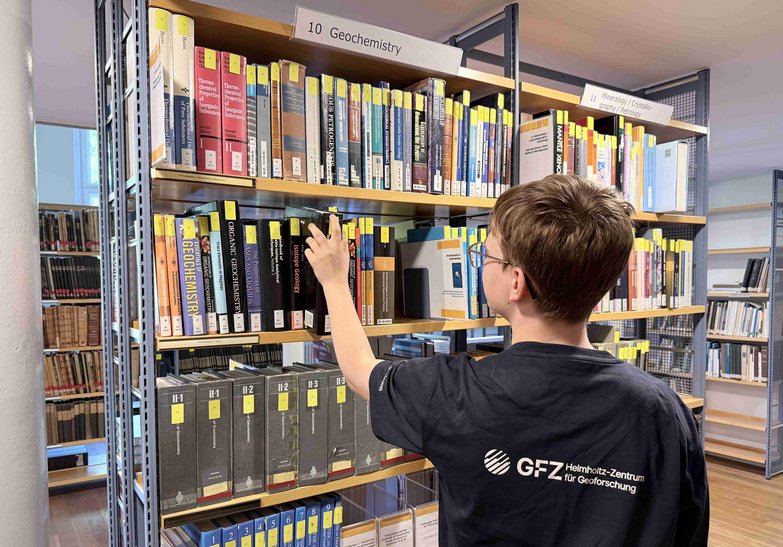
Would you like to learn how information reaches the people who need it and play an active role in organizing knowledge and making it accessible? As a trainee in Media and Information Services (FaMI) at GFZ, you will work in our specialized scientific library in the heart of a research environment. You will learn how to search for and manage literature and research data, catalogue resources, and maintain digital information services. In your role, you will support GFZ scientists in their daily work and help ensure that they can quickly and reliably access the information they need for their research. The training is conducted in German.
About the FaMI Profession
Specialists for Media and Information Services (FaMI) work with information, media and data. They collect, organise, manage and make these resources accessible to others.
The FaMI apprenticeship is currently offered in three specialisations:
Archives · Libraries · Information and Documentation


Internships
Starting in your second year of training, you’ll gain additional hands-on experience through two internships: 3 to 4 weeks each in an archive and a public library. During these internships, you’ll become familiar with other areas of work within the FaMI profession and gain insights into different work methods and target audiences.
You can also complete the internship at a public library abroad for 4 to 6 weeks. The Chamber of Industry and Commerce (IHK) or your vocational school will assist you with the arrangements.

Vocational School
Vocational school classes, which accompany the apprenticeship, take place in three- to four-week blocks at the OSZ Louise-Schröder-Schule in Berlin-Lichterfelde-Süd. You’ll learn important, practical fundamentals for the FaMI profession in the following subjects:
- Media & Information Services (media literacy, research, processing, indexing, managing, and providing information and media)
- Service & Consulting (customer communication and identifying customer needs, offering information and services, developing solutions, and applying basic IT skills)
- Other Subjects: Economics, Social Studies, English, and Physical Education
Here’s what we offer you
- Practical initial training in a modern scientific environment
- Ongoing support from knowledgeable and dedicated instructors
- A laptop provided for the duration of the training
- 30 vacation days per year
- An attractive training stipend: €1,368.26 in the 1st year, €1,418.20 in the 2nd year, and €1,464.02 in the 3rd year (according to the TVöD Bund collective bargaining agreement, as of May 1, 2026)
- Annual bonuses
- Annual allowance for educational materials
- Opportunities for internships abroad
- External and internal continuing education (e.g., in-house language courses)
- Company sports (e.g., soccer, volleyball, table tennis, yoga, etc.)
- Company pension plan
- Subsidy for the Jobticket/Deutschlandticket
Trainees' Experiences
Why did you decide to pursue the FaMI training program? What do you particularly like about the program?
For me, the FaMI training program was an opportunity to learn a profession that would allow me to work in libraries—one that combines hands-on work with theoretical learning right from the start. What I like best is the variety of insights into the entire range of career paths available to FaMIs, thanks to the many internship opportunities. You have plenty of chances to find the career path that suits you best after completing the training.
What surprised you? What did you not expect?
How much of the work is done electronically, and how versatile the work of a library has become. Before my training, I had the traditional image of a library with physical books in my mind, but libraries offer their users so much more—access to databases, academic journals, publication advice, and the use of library spaces are just a few of the services provided by today’s libraries.
I enjoy being a FaMI trainee at the Albert Einstein Science Park Library because...
...the tasks are varied, and during the training program, I can gain in-depth insights into many areas of work at a specialized scientific library; and because I am regarded and valued as a full-fledged member of the team from day one.
Why did you decide to pursue the FaMI training program? What do you like most about it?
This career appeals to me because it combines structured work with a variety of tasks. I find it particularly exciting to catalog media and information and organize them in a way that makes them discoverable and usable by others. The combination of library work, information sharing, and customer service is what particularly drew me to the FaMI training program.
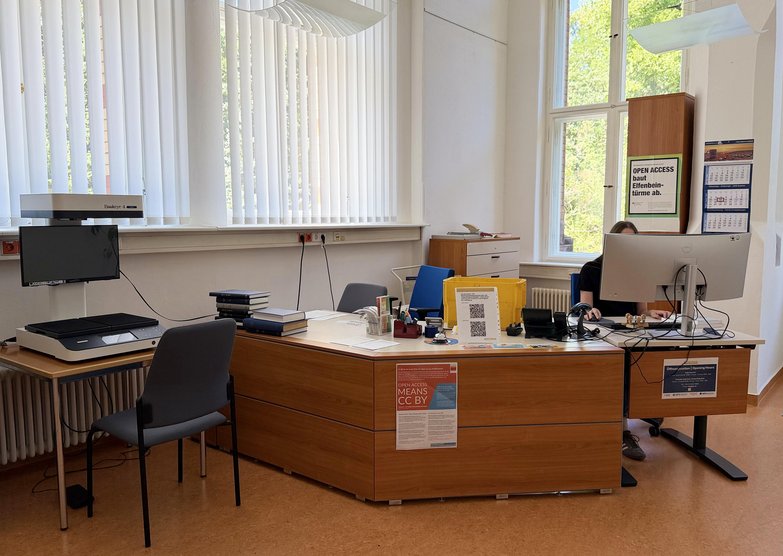
I especially like the variety in the training program. Contrary to the traditional image of library work, the program covers a wide range of tasks, from media acquisition to assisting users at the service desk to interlibrary loan.
What surprised you? What did you not expect?
I was surprised by how independently you can work even during the training program. We’re given our own tasks and projects, and we can also contribute our own ideas and take on responsibility. I also didn’t expect how diverse the work in an academic library is and how many different areas you get to learn about during the training program. In addition to the actual training content, we also gain insights into other work processes relevant to working in an academic library, such as publication and data management or Open Science. This gives you a more comprehensive understanding of how library work is connected to academic processes.
I enjoy being a FaMI trainee at the Albert Einstein Science Park Library because...
...I feel very welcome and supported by the team. Everyone is open, helpful, and takes the time to answer questions when they come up. At the same time, I find the work environment exciting, and Telegrafenberg, with its unique scientific atmosphere and green campus, is a truly beautiful place to work. As a shared library for four scientific institutes, you gain insights into different topics and fields of work, which means you’re always learning something new.